
Change Communications (Why, What, Who and How)
Introduction
The Why, What, Who and How are often called the core pillars of change communication.
They are simple but powerful: if you miss even one, people get confused, resist or disengage.
The 4 Core Questions in Change Communication
1. Why? – The Purpose & Reason
- What it is: The reason behind the change. Why it matters, why now, and why people should care.
- Why it matters: People need meaning before they will commit. Without a clear “why,” change feels like another management fad.
- How to communicate it:
- Link to bigger vision, strategy, or values.
- Share the risks of not changing (cost of status quo).
- Make it personal — explain why it matters to them.
- Example headline: “Why are we changing? To make your workload easier and improve customer service.”
2. What? – The Change Itself
- What it is: The specifics of the change; what is actually happening, what will be different and what success looks like.
- Why it matters: Removes ambiguity; people want to know exactly what’s on the table.
- How to communicate it:
- Describe what’s changing in plain language (tools, process, behaviours).
- Be clear about scope: what is in/what is not.
- Show tangible outcomes or deliverables.
- Example headline: “What’s changing? A single digital platform to replace five outdated systems.”
3. Who? – The People Impacted & Involved
- What it is: Clarifies who is driving the change and who it impacts.
- Why it matters: People instinctively ask, “Does this affect me?” They also want to know who they can trust.
- How to communicate it:
- Identify the decision-makers and sponsors (leaders).
- Clarify who is impacted and how.
- Highlight support available (champions, HR, L&D).
- Example headline: “Who’s involved? Every frontline team will use the new system, supported by trained super-users.”
4. How? – The Path Forward
- What it is: The process, timeline, and support that make the change real.
- Why it matters: Without a roadmap, change feels overwhelming or chaotic.
- How to communicate it:
- Show the timeline or milestones.
- Explain training, tools or resources available.
- Provide clear channels for questions and feedback.
- Reinforce “you’re not alone in this.”
- Example headline: “How will we get there? Step-by-step rollout with training and ongoing support.”
Putting It All Together
A strong change message always covers all four pillars. Example:
- Why: We need faster, more reliable tools to serve customers better.
- What: We’re replacing five old systems with one integrated platform.
- Who: This impacts all staff who manage customer data, supported by IT and champions.
- How: We’ll roll out in 3 stages, with training, FAQs, and helpdesk support.
Summary
The order matters — always start with Why (purpose), then move to What (facts), then Who (people), and finish with How (the path forward). This mirrors how people naturally process information.
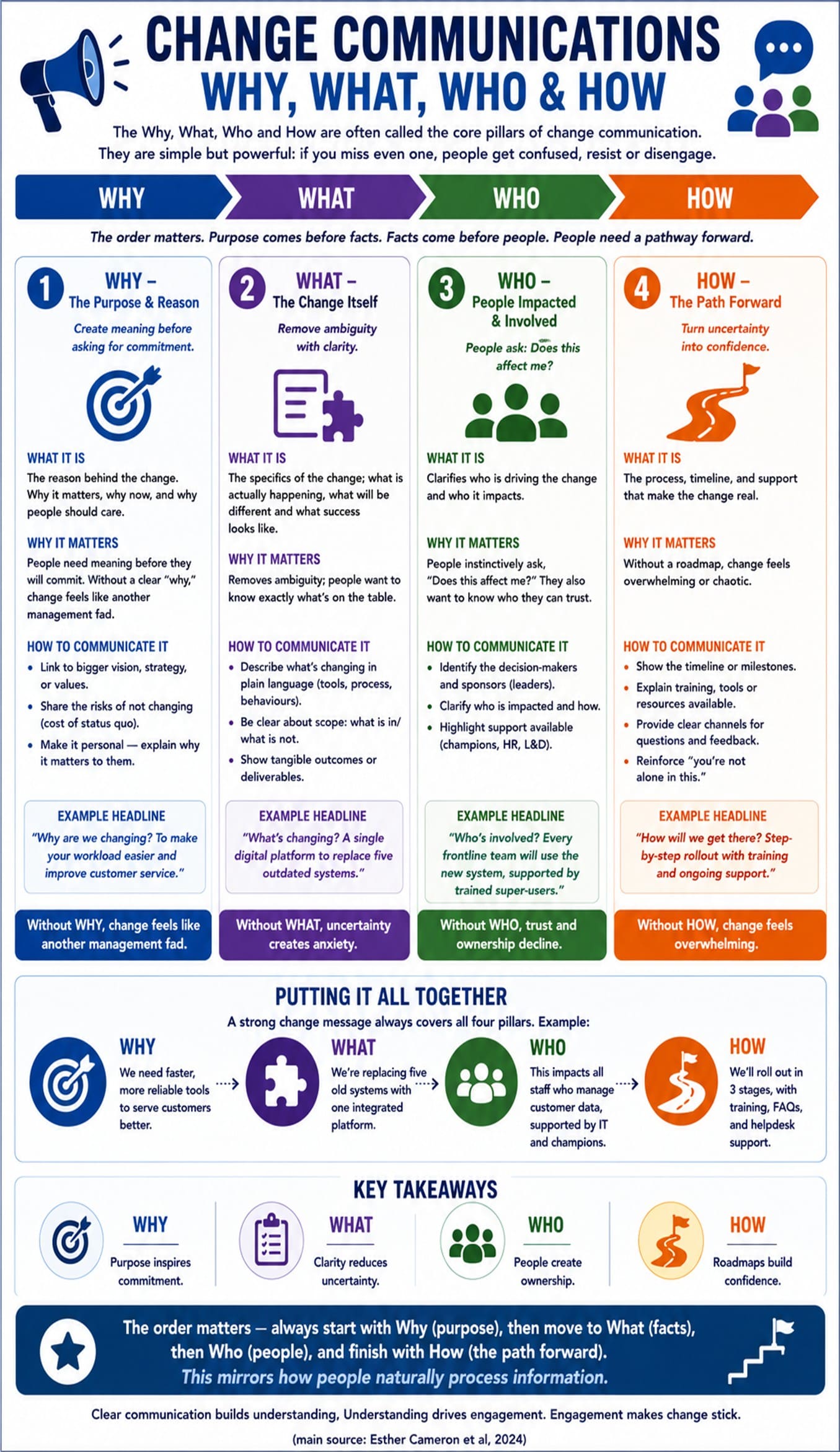
(main source: Esther Cameron et al, 2024)