The Role of Communications
Introduction
This plan represents the communications activity supporting the overall change management for a project. Note that communications alone will not achieve desired outcomes – other elements of change also need to be in action. These are outlined in the diagram below.
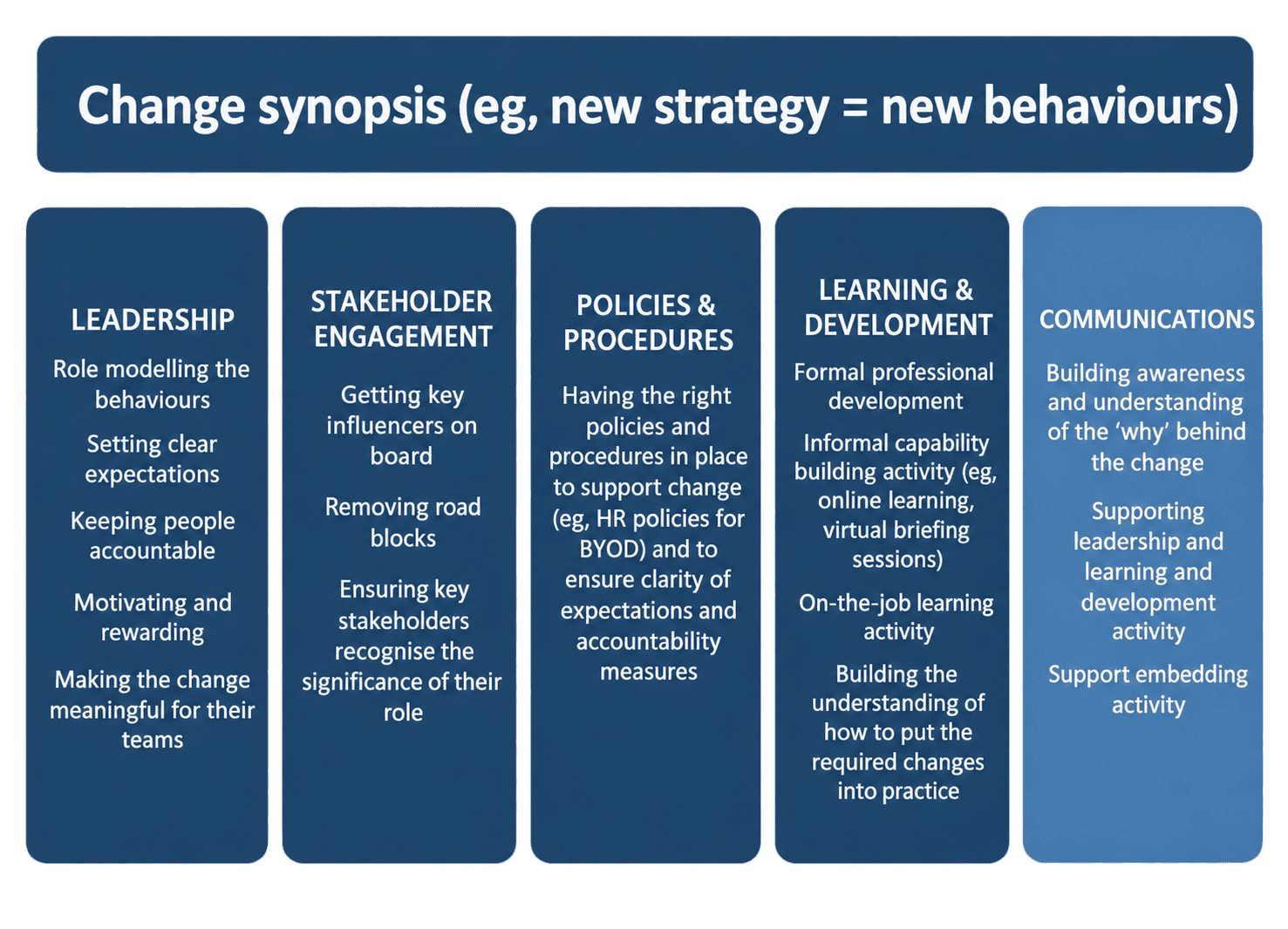
(source: Mel Loy, 2024)
Due to the nature of change communications, some elements of this plan cross over into leadership and learning and development. However, other activity may be required, and advice should be sought from relevant internal teams (eg, L&D) as to what activity is required to best support the change.
Stakeholder engagement is the responsibility of the sponsors / program managers, as is the development of any related governance requirements, such as policies or procedures.
Communications strategy
|
Background: |
Facts about the project/strategy – what has the organisation been doing to date, and what do they want to do differently? |
||||
|
Project objectives: |
This is about the project objectives, not your communication and change objectives. What is it the project trying to achieve? |
||||
|
Communication objectives: |
How will communication tools help support the project objectives? What do you want people to know/ feel/ do? |
||||
|
Communications strategy: |
This is your approach to the communication plan – not your tactics. Ie, this is the ‘how’, and your tactics are the ‘what’ – we’ll get to them further down! For example, you might be taking a predominantly digital-led approach because of the nature of the workforce and the type of change. You might leverage the voices of key influencers in the business to help drive awareness, understanding and acceptance. |
||||
|
Stakeholders: |
|||||
|
End users |
Change leaders |
Change sponsors/influencers |
|||
|
Who are the people who are most impacted but have little influence over the change? |
Who are the leaders who need to drive the change? |
Who has a voice in the business you can leverage? |
|||
|
Measurement: |
|||||
|
Outcome |
Measurement methodology |
KPI |
|||
|
Refer to your communication objectives – eg, build awareness, understanding and acceptance of the change |
How you will measure success – eg, regular pulse surveys; update of change comms activity (eg, downloads of resources, participation in training, etc)? |
What are the actual figures you can put against these measures? For example, a minimum of 80% of employees strongly agree or agree the changes are worthwhile |
|||
|
Considerations and assumptions: |
|||||
|
What are some of the assumptions and considerations you need to ensure your key stakeholders understand? Eg, assumption: there will be the required internal and external comms resources to implement the strategy; other change activity will take place concurrently; there will be budget allocated to comms activity, etc Considerations could include potential roadblocks, other projects also going live in the business, changes in the external environment |
|||||
(main source: Mel Loy, 2024)
Communication plan
|
|
PHASE 1: Build Awareness |
PHASE 2: Engage |
PHASE 3: Embed |
|
Timing |
At launch of new strategy (following Board sign-off end June) |
As soon as possible following launch |
Ongoing |
|
Purpose |
The purpose of this phase is to build awareness of the transformation, particularly with leaders so they can help drive the change within their teams |
The purpose of this phase is to begin to bring stakeholders on the journey – sharing the strategy narrative in authentic ways, inviting active participation |
The purpose of this phase is to build a change-ready culture internally, maintain momentum, and secure the support of all key stakeholders |
|
Desired stakeholder outcomes |
|||
|
Know |
What’s changing, when, why, the benefits |
Why the change has occurred, what I need to do differently, where to find support |
How this change fits in with the overall program; what else to expect |
|
Feel |
Excited, relieved (they’re finally fixing that!), supported |
Supported, clear on what to do / why / how, confident in my role to play |
Heard, valued, confident in the organisation to deliver further change |
|
Do |
Start accessing learning resources, advocating for the change with colleagues |
Share feedback, start using the system, advocate for the system with colleagues |
Keep using the new system, advocate, support further digital change |
|
Communications strategies |
|||
|
|
· Leverage the voice of influential leaders to introduce the change; make the compelling case for ‘why’ (WIIFM); be clear on what’s changing, when and how · Introduce the changesto leaders and show how the changes will positively impact them over the next three years · Start providing engagingcontent and encourage people to familiarise themselves with the change · Use highly visual and engaging tools/comms – steer away from typical passive channels · Drive use of new channels by having information / helpful content exclusively available on those channels · Provide live comms events (virtual) to build awareness and understanding, and provide a two-way communication channel |
· Introduce the changes to all stakeholders and show how the changes will positively impact them over the next 3 years · Use personas (recognisable types) to start demonstrating how each project benefits a key stakeholder group · Encourage active participation from team members through the use of two-way conversation channels, and encouraging story sharing using the personas · Implement a feedback mechanism to demonstrate commitment to continuous improvement · Have key leaders role model the changes · Ensure support/help tools are easy to find via multiple touchpoints – visual, clear, simple · Have a sense of excitement through team competitions/ fun activities – eg, hidden ‘easter eggs’, first person to use the system, etc · Provide leaders with the tools to unpack the strategy with their team |
· Demonstrate success – share key wins · Share feedback – show how we’re responding to constructive feedback (we heard you … so we are going to …) · Show how each individual project demonstrates overall program progress to keep people motivated and interested in the next step · Continuously reiterate key messages about the ‘why’ and the outcomes we’re striving to achieve · Continuously refer back to the personas and show how the changes are impacting them in a positive way |
|
Communications tactics |
|||
|
Employees/ leaders |
· Email from CEO with video from Chairman – introducing the new strategy at a high-level; building excitement; sharing the ‘why’ · SharePoint resources – linked in emails / during Teams briefings (include overview of changes, FAQs, etc) · Video / animation outlining the change journey, the strategy, the why · Microsoft Teams briefings for leaders – outlining what’s changing and why, and their role to play · Online resource hubs – for end users, and for leaders, with FAQs, user guides where applicable, videos, sections outlining each persona and the benefits of the changes for each · Mentions in team meetings/ regular 1:1s |
· Town Halls/CEO Roadshows introducing the strategy, the personas, and the change roadmap (including inputs from other key leaders involved in the changes) · Microsoft Teams briefings /messages · Video/animation/ infographics of ‘how to’ and demonstrating impacts on key stakeholder groups · User guides/FAQs etc on SharePoint · Briefings from Change Champions · Posters in key areas with links to information · PC desktop with graphic/ message · Intranet home page banner/ lead story · Ongoing updates to the online resource hubs · Mentions in team meetings/ regular 1:1s |
· Intranet articles demonstrating successes · Yammer group to share stories (and embed on intranet home page) · CEO Town Halls/Roadshows every six months with progress update; reiterating key messages; sharing successes · Ongoing updates to the online resource hubs · Regular email / newsletter from the CEO sharing successes, reiterating key messages etc · Mentions in team meetings/ regular 1:1s · Feedback sessions – reviewing feedback received, what to take on board/ actions required |
|
External stakeholders |
· Overview of the strategic vision and the roadmap; strategic narrative – info pack/online presentation/ video (linked from regular email/newsletter) |
· Media release where newsworthy milestones are met – focus on trade media · LinkedIn post from the CEO; LinkedIn article on company profile |
· Update any key journalists as major/newsworthy milestones are met – phone conversation · Update key external stakeholders/vendors as required – phone/email · Continued updates to external providers via regular comms channels – eg donor newsletters/emails/events · Regular articles/posts on LinkedIn, Facebook |
|
Clients |
· Website homepage articles · Social media posts – eg, Instagram, Facebook · Info via contact with team members (who will be equipped with FAQs and speaking points) |
· Website homepage articles · Social media posts – eg, Instagram, Facebook · Info via contact with team members (who will be equipped with FAQs and speaking points) |
|
|
Channels and collateral |
|||
|
Channels |
· Email from senior leaders · SharePoint hub with info about the strategy · Posters / desk stickers · Screensavers/lock screens · Microsoft Teams · Facebook, Instagram · SharePoint home page ‘intranet’ |
· As per phase 1, plus: · CEO Roadshow/Town Halls (live, virtual and pre-recorded) · Intranet home page (and development of entire digital workplace platform over time) · Regular CEO Email or newsletter with CEO message – link to videos · Any additional social channels – eg, TikTok? |
· As per phases 1 and 2, plus: · Yammer · Mobile-ready/BYOD accessible news and resources via established Microsoft apps · Podcasts · Chatbots |
|
Collateral |
· Videos / animations · Infographics for digital and social channels · Speaking points and FAQs for leaders · Posters / desk stickers · Slide packs for leaders |
· As per phase 1, plus: · Intranet banners · Intranet articles |
· As per phases 1 and 2, plus: · Graphics/info to send to mobile platforms |
(main source: Mel Loy, 2024)
Template to be Completed (communication sequence)
Note that the communication sequence will be overlayed with individual program change communications from the ‘Engage’ phase onwards. This will require a centralised and coordinated approach.
|
Seq |
Timing |
Audience |
Voice |
Channel |
Message |
Collateral |
Responsible |
|
Phase 1 – Build Awareness |
|||||||
|
1. |
2 weeks prior to launch |
Leaders |
CEO |
Virtual briefing |
Overview of the new strategy; how it’s been developed, what we’re trying to achieve, etc Leaders’ role to play in driving the change – set expectations Q&A time |
Slide pack |
Internal comms |
|
2. |
|
||||||
|
3. |
|
||||||
|
Phase 2 – Engage |
|||||||
|
4. |
|
||||||
|
5. |
|
||||||
|
6. |
|
||||||
|
7. |
|
||||||
|
8. |
|
||||||
|
9. |
|
||||||
|
10. |
|
|
|||||
|
11. |
|
|
|||||
|
Phase 3 – Embed |
|||||||
|
12. |
|
||||||
|
13. |
|
||||||
|
14. |
|
||||||
|
15. |
|
||||||
|
16. |
|
||||||
|
17. |
|
||||||
|
18. |
|
||||||
|
19. |
|
||||||
|
20. |
|
||||||
(main source: Mel Loy, 2024)