
The Resilience Plan (4 S’s)
Introduction
“…People can bounce back from adversity, trauma, tragedy, threats, or significant sources of stress because of their inherent resilience: the process of, capacity for, or outcome of successful adaptation despite challenging circumstances……Resilience is associated with inner strength, competence, optimism, flexibility and the ability to cope effectively when faced with adversity, and minimising the effect of risk factors, such as stressful life events, and enhancing protective factors, such as optimism, social support and active coping, increasing people's ability to deal with life's challenge. Resilience is not a trait that people either have or do not have. It involves behaviours, thoughts and actions that can be learned and developed in anyone…”
Hugho Alberts et al, 2025a
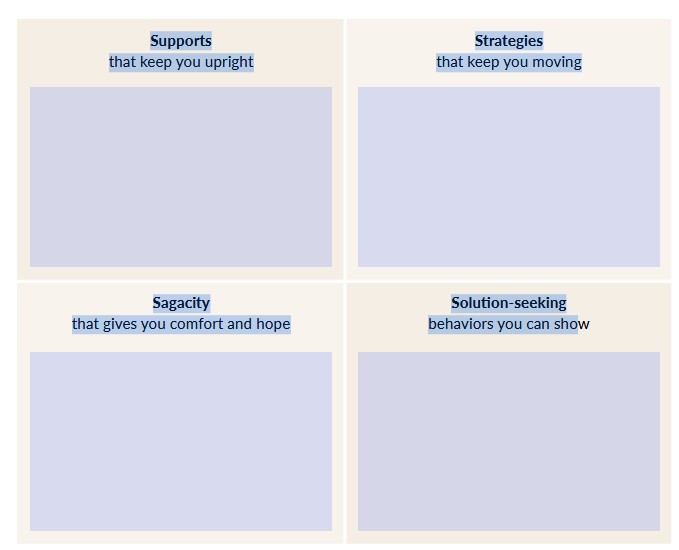
A way to develop resilience is to draw on one's learning from similar past challenges. Some examples include
- what support was used
- what strategies were developed
- what sagacity (wisdom and insight) was used
- what solutions were found, etc.
Four Pillars (4Ss)
This is a widely used evidence-based framework for strengthening resilience which breaks it down into 4 pillars: Self, Situation, Supports and Strategies. These help individuals regulate stress, adapt to uncertainty and maintain effectiveness under pressure.
1. Self
It is your internal resources, eg mindset, identity, values, emotions, self-talk, confidence and sense of purpose.
Key elements:
- Emotional regulation
- Growth mindset
- Values clarity
- Self-efficacy (“I can handle this”)
- Personal boundaries.
When change hits, people first scan inward: “Can I cope?”
If “Self” is strong, they stay adaptive. If not, threat responses (avoidance, anxiety, resistance, etc) rise.
2. Situation
Understanding what is actually happening, ie facts, risks, control points, what’s changing vs what’s stable, etc.
Key elements:
- Accurate situational appraisal
- Separating fact from story
- Controllables vs. uncontrollables
- Identifying constraints and options.
NB People are less stressed when they can make sense of the change, even if they don’t like it. Cognitive understanding reduces emotional overload.
3. Supports
The people, systems and communities that help you stay grounded and capable.
Key elements:
- Social support (peers, leaders, mentors, etc)
- Organisational support (training, tools, clarity, etc)
- Psychological safety
- Team rituals that reinforce belonging.
NB Support reduces stress. It transforms “change happening to me” into “change we’re working through together.”
4. Strategies
Practical actions that help you cope and move forward.
Key elements:
- Problem-solving plans
- Micro-habits that stabilise energy
- Managing workload
- Stress-management techniques
- Recovery strategies.
NB People are more resilient when they have something they can do; even small steps restore agency.
Resilience Plan
Evaluate your resilience plan
Answer the following questions to evaluate the effectiveness of your resilience plan: “…
- How was it for you to carry out your resilience plan? Did it help you bounce back from this difficulty?
- What resources (specific skills/supports/strategies/sagacity) were most helpful to you? Why?
- What resources (specific skills/supports/strategies/sagacity) were least helpful to you? Why?
- Did you not use any resources, and if so, why not?
- Is there anything you would like to add to your resilience plan?
- In what other areas of your life could you use your resilience plan? How might things improve
for you?...”
Hugho Alberts et al, 2025a