
Leadership Tax
Introduction
The leadership tax is the hidden cost an organization incurs when leaders are ineffective, misaligned or fail to create a healthy, high-performing environment.
The “leadership tax” is not a literal financial tax, but a metaphor used in management, organizational psychology and leadership studies. It refers to the extra costs—in time, energy, stress or lost opportunities—that an organization or leader pays because of poor leadership practices.
Poor leadership is the main driver of disengagement in organisations
“…Poor leadership silently drained performance - like a leaky tap no one bothers to fix…….as the change is getting bigger and bigger……it becomes one drip at a time, until you're flooded…”
Tim Baker, 2025.
Poor leadership results in
“… - Deadlines get missed
- People do their minimum
- Burnout spreads like the flu
- And eventually, top talent walks out the door…”
Tim Baker, 2025
Sources of Leadership Tax
| Source | What It Looks Like | Cost to Organization |
|---|---|---|
| 1. Poor Decision-Making | Bottlenecks, indecisiveness, constant rework | Delays, missed opportunities |
| 2. Lack of Vision & Alignment | Teams unsure of priorities | Wasted effort, duplication |
| 3. Toxic Behaviours | Micromanagement, blame culture | Low morale, turnover |
| 4. Weak Communication | Mixed messages, lack of clarity | Errors, conflict |
| 5. Change Mismanagement | Confusion, resistance | Slow adoption, project overruns |
| 6. Innovation Suppression | Fear of failure, no empowerment | Stagnation, competitive loss |
Symptoms in Daily Operations
- High employee turnover
- Low engagement & productivity
- Projects over budget/time
- “Invisible work” fixing mistakes
- Talent under-utilised
Impact
- Direct costs: recruitment, training, rework, overtime, etc
- Indirect costs: burnout, loss of trust, reputation damage, etc
- Opportunity costs: missed innovations, slow growth, etc
Some Ways to Reduce Leadership Tax
- Self-Awareness & Emotional Intelligence: leaders know their impact
- Clarity & Consistency: decisions and direction are transparent
- Empowerment & Trust: people own outcomes
- Feedback & Coaching: continuous leadership development
- Change Leadership Skills: guide people through transitions effectively
Using a Visual Metaphor
Imagine 2 organizations building the same house:
- One has effective leaders, resulting in resulting in smooth workflow, fewer mistakes, quicker build.
- The other has poor leaders resulting in constant rework, wasted materials, worker frustration.
The extra cost of wasted time and effort = Leadership Tax.
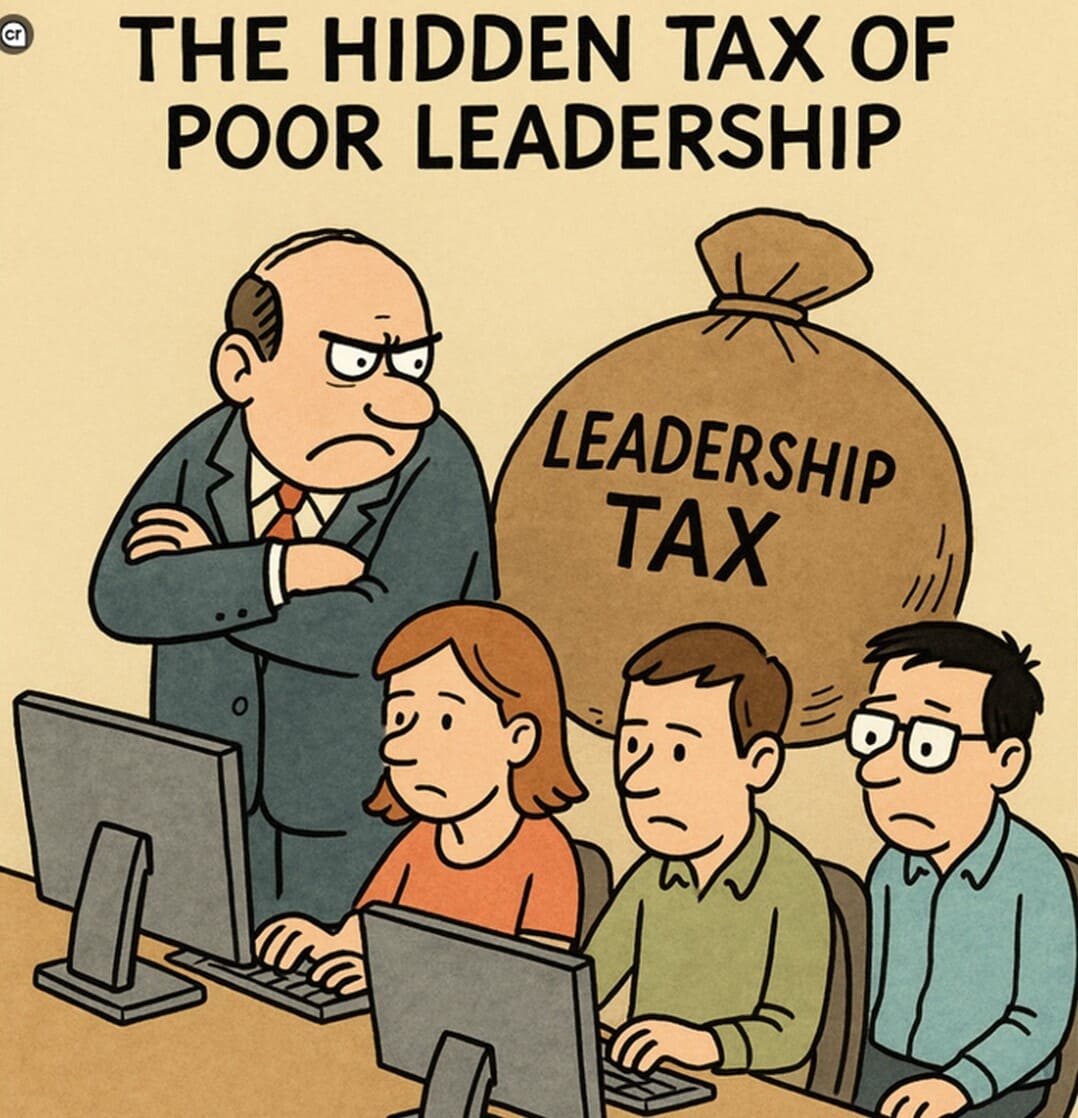
(source: Tim Baker, 2025)
Some Examples of Leadership Tax
- Decision Bottlenecks (when a leader insists on approving everything, slowing down projects)
- High Turnover Costs (people leave because of toxic or weak leadership, forcing costly recruitment and training)
- Low Engagement (staff disengage due to lack of vision or recognition, reducing productivity)
- Change Resistance (poorly managed change creates confusion, requiring extra time, rework and morale repair)
- Communication Gaps (misunderstandings or lack of clarity cause errors, duplication of effort or missed opportunities.)
- Innovation Stifling (when leaders micromanage or punish failure, teams avoid risk-taking, slowing progress.)
Symptoms of Leadership Tax
How It Shows Up in Daily Work
- Meetings drag on because the leader cannot make decisions.
- Employees “check out” mentally and do the bare minimum.
- Projects exceed budgets or timelines because leadership direction keeps shifting.
- A talented employee leaves, costing the company months of replacement effort.
Some Reasons it is Called a “Tax”
Because, like a real tax:
- Inevitable (if poor leadership exists)
- Cumulative (small inefficiencies build into large costs)
- Avoidable or reducible (with better leadership skills, culture and systems)
Some Ways to Reduce Leadership Tax
- Develop leaders’ self-awareness and emotional intelligence.
- Encourage clear decision-making frameworks.
- Foster trust and empowerment instead of micromanagement.
- Align leadership practices with organizational strategy and values.
- Invest in coaching and feedback loops to strengthen leadership skills.
Summary
Leadership tax is the penalty an organization pays for ineffective leadership, showing up as wasted resources, lost talent and missed opportunities; it is the hidden costs (time, energy, money, opportunity) an organization pays due to ineffective leadership.
The Leadership Tax is avoidable.
Investing in leadership capability turns a hidden cost into a competitive advantage.
Rather than being the drain, leadership can be the fuel for good performance, as it can
- develop trust that creates loyalty
- develop clarity that reduces wasted effort
- encourages feedback that improves performance
- unlocks innovation
- creates alignment that can channel energy.
As a result,
“…People thrive instead of burning out. Teams collaborate instead of colliding. Organisations grow the leadership…”
Tim Baker, 2025
Good leadership creates more than healthier balance sheets and profit and loss accounts; it creates a workplace where people want to be.
“…Poor leadership is expensive. Great leadership is priceless…”
Tim Baker, 2025