Dysfunctional Relationships (Drama Triangle)
Introduction
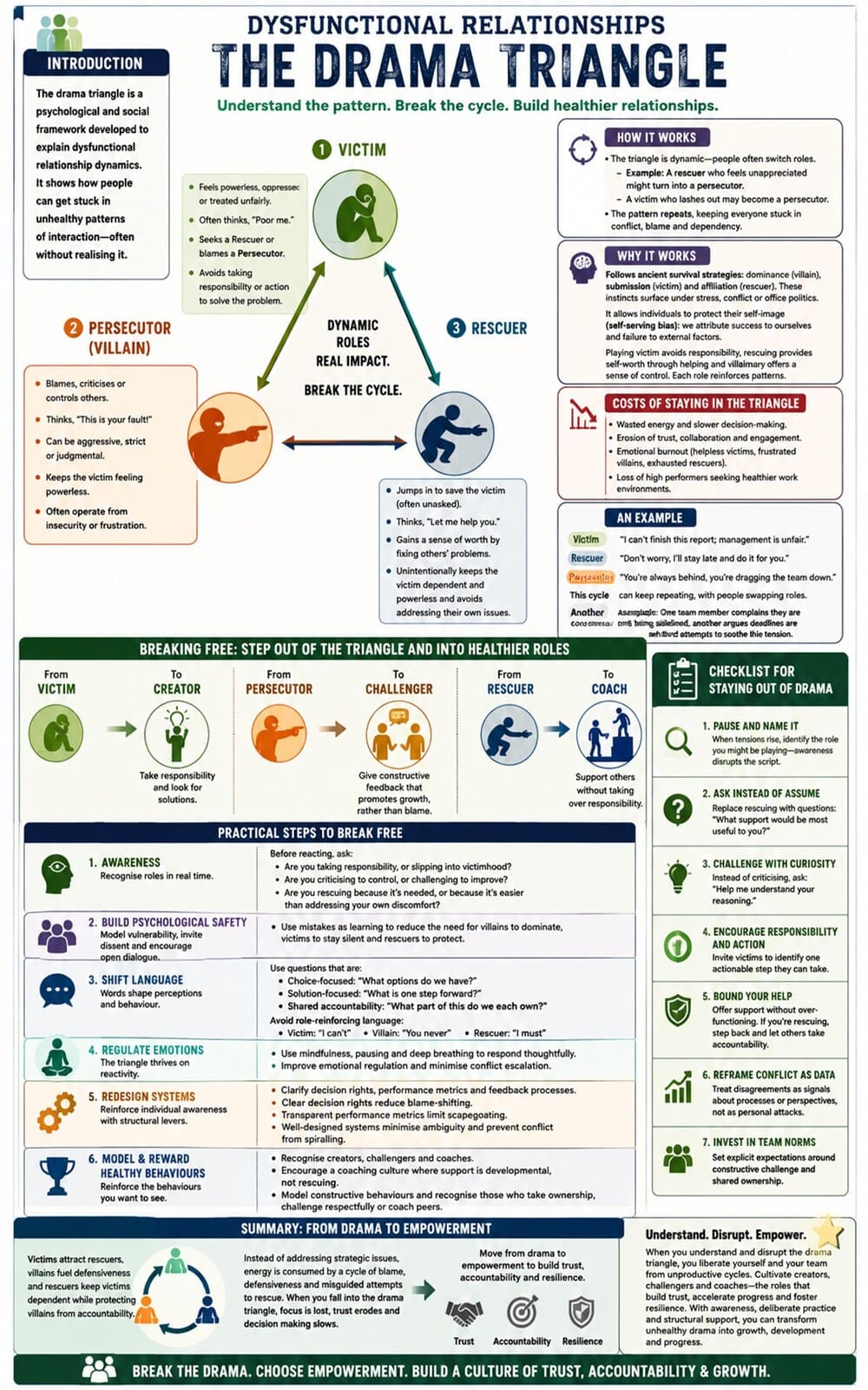
The drama triangle is a psychological and social framework developed to explain dysfunctional relationship dynamics. It shows how people can get stuck in unhealthy patterns of interaction, often without realising it.
Three roles in Triangle:
1. Victim
- Feels powerless, oppressed or treated unfairly.
- Often thinks, “Poor me”.
- Seeks a Rescuer or blames a Persecutor.
- Avoids taking responsibility or action to solve the problem.
2. Persecutor (Villain)
- Blames, criticises or controls others.
- Thinks, “This is your fault!”
- Can be aggressive, strict or judgmental.
- Keeps the victim feeling powerless.
- Often operates from insecurity or frustration
3. Rescuer
- Jumps in to save the victim (often unasked).
- Thinks, “Let me help you.”
- Gains a sense of worth by fixing others’ problems.
- Despite appearing supportive, they can unintentionally keep the victim dependent and powerless and avoid addressing their own issues.
How It Works
- The triangle is dynamic — people often switch roles.
- Example: A rescuer who feels unappreciated might turn into a persecutor.
- A victim who lashes out may become a persecutor.
- The pattern repeats, keeping everyone stuck in conflict, blame and dependency.
Why It Works
- Humans are wired for survival through group dynamics (follows ancient survival strategies: role of dominance (villain), submission (victim) and affiliation (rescuer); these instincts appear when under stress, conflict or office politics dominate)
- It allows individuals to protect their self-image (self-serving bias
“…Shows people habitually interpreted events in ways that their self-esteem……Self-serving bias is both persuasive and adaptive for maintaining self-image, with people attributing success to themselves and failure to external factors. Playing victim avoids responsibility, rescuing provides self-worth through helping and villainy offers a sense of control. Each role reinforces patterns……Lastly, environments that reward firefighting over prevention, or scapegoating over accountability, amplify these dynamics…”
Michelle Gibbings, 2025f)
Costs of Staying in the Triangle
- Wasted energy and slower decision-making.
- Erosion of trust, collaboration and engagement.
- Emotional burnout (helpless victims, frustrated villains, exhausted rescuers).
- Loss of high performers who seek healthier work environments.
An Example
Imagine a workplace situation:
- Victim: “I can’t finish this report; management is unfair.”
- Rescuer: “Don’t worry, I’ll stay late and do it for you.”
- Persecutor: “You’re always behind, you’re dragging the team down.”
This cycle can keep repeating, with people swapping roles.
Another example
“…One team member is complaining that they are constantly being sidelined (“No one listens to me”), another argues that deadlines are being ignored (“If you’d just deliver on time, we wouldn’t be in this mess”), while a third attempts to soothe the tension (“Let’s not be harsh. Let me fix this.”)…”
Michelle Gibbings, 2025f
Breaking Free
The goal is to step out of the triangle and into healthier roles:
- Victim becomes a Creator (takes responsibility and looks for solutions.)
- Persecutor becomes a Challenger (give constructive feedback that promotes growth, rather than blame.)
- Rescuer becomes a Coach (supports others without taking over responsibility.)
Some Practical Steps to Break Free
- Awareness (recognise roles in real time; before reacting, ask the following questions: “…
- Are you taking responsibility, or slipping into victimhood?
- Are you criticising to control, or challenging to improve?
- Are you rescuing because it’ s needed, or because it’s easier than addressing your own discomfort?…”
Michelle Gibbings, 2025f)
- Build psychological safety (model vulnerability, invite dissent and encourage open dialogue; use mistakes as learning so that there is a reduction in the need for villains to dominate, for the victim to stay silent, for the rescuers to protect)
- Shift language (constructively use linguistic framing: subtle shifts in word choice shape perceptions and behaviour; use questions that are
- choice-focused, like ‘What options do we have?’
- solution-focused, like ‘What is one step forward?’
- normalise shared accountability, like ‘What part of this do we each own?’
NB Generally, victims can use absolutes, eg ‘I can't’, villains can use blame, eg ‘you never’ and rescuers use obligation, eg ‘I must”.
“…The language you use can reinforce the roles you (and those around you) adopt…”
Michelle Gibbings, 2025f)
- Regulate emotions (the triangle thrives on reactivity; to handle this, use mindfulness, pausing and/or deep breathing to respond thoughtfully; this will improve the emotional regulation and minimise conflict escalation)
- Redesign systems (reinforce individual awareness structural levers; clarify decision rights, performance metrics and feedback processes.
“…Clear decision rights help reduce blame-shifting, while transparent performance metrics limit the tendency to scapegoat……when systems are well designed, they minimise ambiguity and prevent conflict from spiralling…”
Michelle Gibbings, 2025f)
- Model and reward healthy behaviours (recognise creators, challengers and coaches; encourage a coaching culture where support is developmental rather than rescuing.
“…By modelling constructive behaviours and recognising those who take ownership, challenge respectfully, or coach peers, you reinforce healthier dynamics and signal what is valued…”
Michelle Gibbings, 2025f)
Checklist for Staying Out of Drama
- Pause and Name It (when tensions rise, identify the role you might be playing; awareness disrupts the script)
- Ask Instead of Assume (replace rescuing with questions: “What support would be most useful to you?”)
- Challenge with Curiosity (instead of criticising, say: “Help me understand your reasoning.”)
- Encourage Responsibility and Action (invite victims to identify one actionable step they can take)
- Limit Your Help (offer support without over-functioning; if you’re rescuing, step back and let others take accountability.)
- Reframe Conflict as Data (treat disagreements as signals about processes or perspectives, not as personal attacks.)
- Invest in Team Norms (set explicit expectations around constructive challenge and shared ownership)
Summary
A Drama Triangle usual develops this way:
“…Victims attract rescuers, villains fuel defensiveness and rescuers keep victims dependent while protecting villains from accountability……Instead of addressing the strategic issues, energy becomes consumed by a cycle of blame, defensiveness and misguided attempts to rescue……When you fall into the drama triangle, you and your team lose focus, trust erodes and decision making slows…”
Michelle Gibbings, 2025f
Moving from drama to empowerment builds trust, accountability and resilience. Leaders play a crucial role in disrupting the cycle by modelling constructive behaviour and creating systems that support empowerment over drama.
“…When you understand and disrupt the drama triangle, you liberate yourself and your team from unproductive cycles. Instead of victims, villains, and rescuers, you cultivate creators, challengers, and coaches. These are the roles that build trust, accelerate progress, and foster resilience. As workplaces grow more complex, the temptation to fall into old scripts will persist. But with awareness, deliberate practice, and structural support, you can transform unhealthy drama into growth, development and progress…”
Michelle Gibbings, 2025f