
Difference in Awareness and Granular Approaches in Communications
Introduction:
Both awareness approaches and granular approaches are used in change communications, but they operate at different levels of detail and serve different purposes.
1. Awareness Approach
Purpose: To create broad understanding that change is happening and why it matters.
Audience: Entire workforce or large groups.
Style: High-level, simplified, inspiring.
Focus:
- Big picture (“why the change is needed”)
- Key benefits for the organization
- High-level timeline or milestones
Channels: Town halls, newsletters, intranet updates, posters, launch videos.
Strengths: Builds momentum, reduces rumours, signals leadership commitment.
Limitations: Too broad for employees to understand exactly what it means for them.
Example:
“We’re moving to a new digital system next year to improve efficiency and customer experience.”
2. Granular Approach
Purpose: To provide detailed, role-specific information so people know exactly how to adapt.
Audience: Specific groups, teams or individuals.
Style: Practical, tailored, instructive.
Focus:
- “What does this change mean for me?”
- New processes, workflows, and expectations.
- Detailed training, step-by-step guides, FAQs.
Channels: Team briefings, manager cascades, training workshops, job aids, FAQs, 1:1 conversations.
Strengths: Builds capability, reduces confusion, helps adoption.
Limitations: Can feel overwhelming if shared too early without broader context.
Example of apt communication to a team already aware of changes:
“Further to the recently announced plans. From next Monday, customer service staff will log calls into the new CRM system. Training on how to use the case logging function is scheduled for this Thursday.”
Key Differences
| Aspect | Awareness Approach | Granular Approach |
|---|---|---|
| 1. Focus | Big picture, why change is happening | Practical details, how to do it |
| 2. Audience | Broad, all employees | Specific groups or individuals |
| 3. Timing | Early in the change journey | Later, as implementation nears |
| 4. Tone | Inspiring, high-level | Detailed, instructional |
| 5. Tools | Town halls, newsletters, videos | Team briefings, training, FAQs |
Summary
Effective change communication requires both approaches, sequenced properly:
- Start with awareness (build understanding and emotional readiness).
- Follow with granular communications (give tools and detailed guidance).
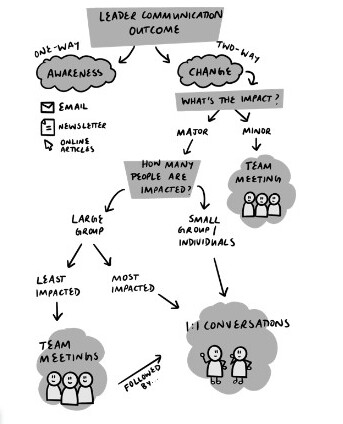
(source: Mel Loy, 2024)