
Change Management (5 Key Elements)
Introduction
Understanding the 5 elements of change management:
- Leadership
- Stakeholder engagement
- Governance
- Learning and Development
- Communications
Key Elements of Change
i) Leadership
What it means:
The visible, active sponsorship and role-modelling of change by leaders at all levels: executives, line managers and informal influencers.
Why it matters:
- People look to leaders for cues on whether change is real, urgent and safe.
- Research shows leadership sponsorship is the #1 success factor in change adoption.
How to do it well:
- Visible sponsorship: Leaders attend town halls, speak in videos and personally explain the “why.”
- Role-modelling (leaders act in alignment with the new behaviours (not just talk about them), help remove roadblocks, act upon feedback, etc.)
- Empowerment: Equip leaders with talking points, FAQs, and coaching so they can confidently answer questions.
- Consistency: Leaders reinforce the change repeatedly, not just once at launch.
ii) Stakeholder Engagement
What it means:
Proactively involving and collaborating with everyone who is impacted by, or can influence, the change — from frontline employees to unions, suppliers, customers, or community groups.
Why it matters:
- Stakeholders who feel heard are far more likely to support the change.
- Early engagement identifies risks, concerns and practical barriers before they become roadblocks.
How to do it well:
- Stakeholder mapping: Identify who is impacted, their level of influence and what matters to them.
- Co-design/co-creation: Where possible, involve stakeholders in designing solutions (builds ownership).
- Feedback loops: 2-way engagement: surveys, workshops, pilot groups, etc, not just top-down messages.
- Segmented approach: Different groups need different levels of detail and involvement.
iii) Governance (internal & external)
Governance (Internal)
What it means:
Having clear decision-making structures, roles and accountabilities to steer the change, eg code of conduct.
Why it matters:
- Prevents decision bottlenecks, conflicting priorities and scope creep.
- Provides a “single source of truth” for approving changes, messages and resources.
How to do it well:
- Change steering committee: Senior leaders who meet regularly to review progress and remove roadblocks.
- Clear RACI: Who is Responsible, Accountable, Consulted, and Informed for each decision.
- Escalation paths: Clear process for resolving issues quickly.
Government (External)
If the change affects regulation, funding or policy (common in public sector):
- Engage early: Brief government stakeholders, anticipate compliance requirements.
- Policy alignment: Ensure the change supports legislation or sector priorities.
- Transparency: Provide progress reports to regulators or ministers if needed.
iv) Learning and Development (L&D)
What it means:
Building the skills, knowledge and confidence people need to work in the new way after the change.
Why it matters:
- People don’t resist change as much as they resist feeling incompetent.
- Without training and support, adoption drops and performance suffers.
How to do it well:
- Training needs analysis: Identify skills gaps created by the change.
- Just-in-time learning: Provide learning close to when people need to use it.
- Variety of formats: Classroom, e-learning, job aids, simulations, mentoring.
- Reinforcement: Post-training refreshers, coaching, and quick reference guides.
v) Communications
What it means:
The planned, consistent and audience-centred messaging that helps people understand, accept and act on the change; it
“…requires a deep understanding of humans, and of the change, and putting those two things together…”
Mel Loy, 2024
Why it matters:
- Communication shapes perception — it can build trust, reduce anxiety and create alignment.
- Poor communication is one of the most cited reasons for change failure.
How to do it well:
- Clarity: Avoid jargon, be transparent about what’s known and unknown.
- Consistency: Use a central message framework so all channels say the same thing.
- Emotion + logic: Explain the “why” (purpose) and the “what” (facts) together.
- Two-way channels: Encourage questions and dialogue; don’t just broadcast.
- Multi-channel: Email, town halls, intranet, video, team meetings, etc; reach people where they are.
Summary
Learning how people respond to change, including emotional, rational and behavioural responses. Tailoring communication for different audiences (recognising that people have diverse needs, contexts, emotional states).
Understanding the principles that guide effective change communication.
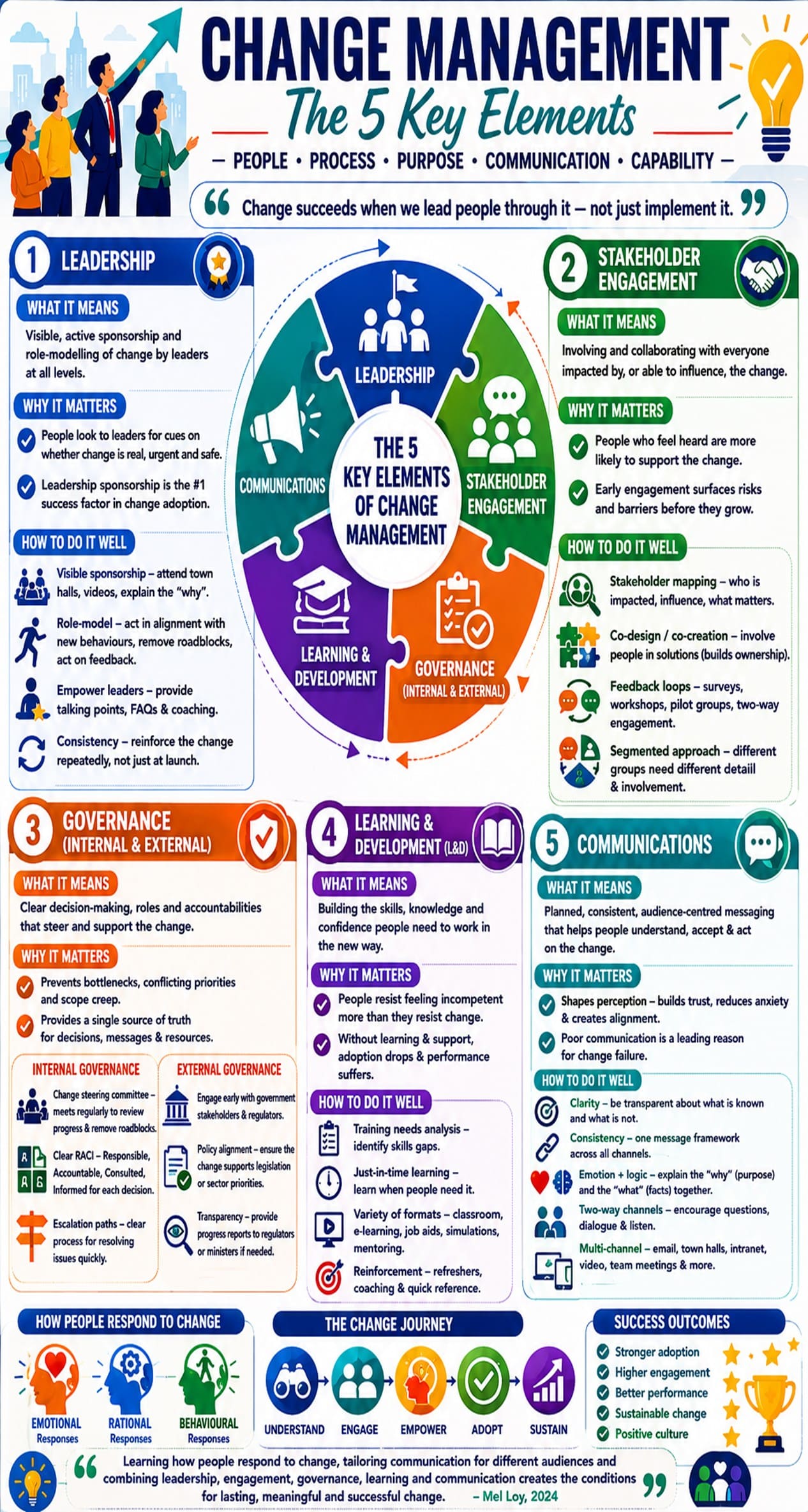
(main source: Mel Loy, 2024)