
Loss Aversion Theory
Introduction
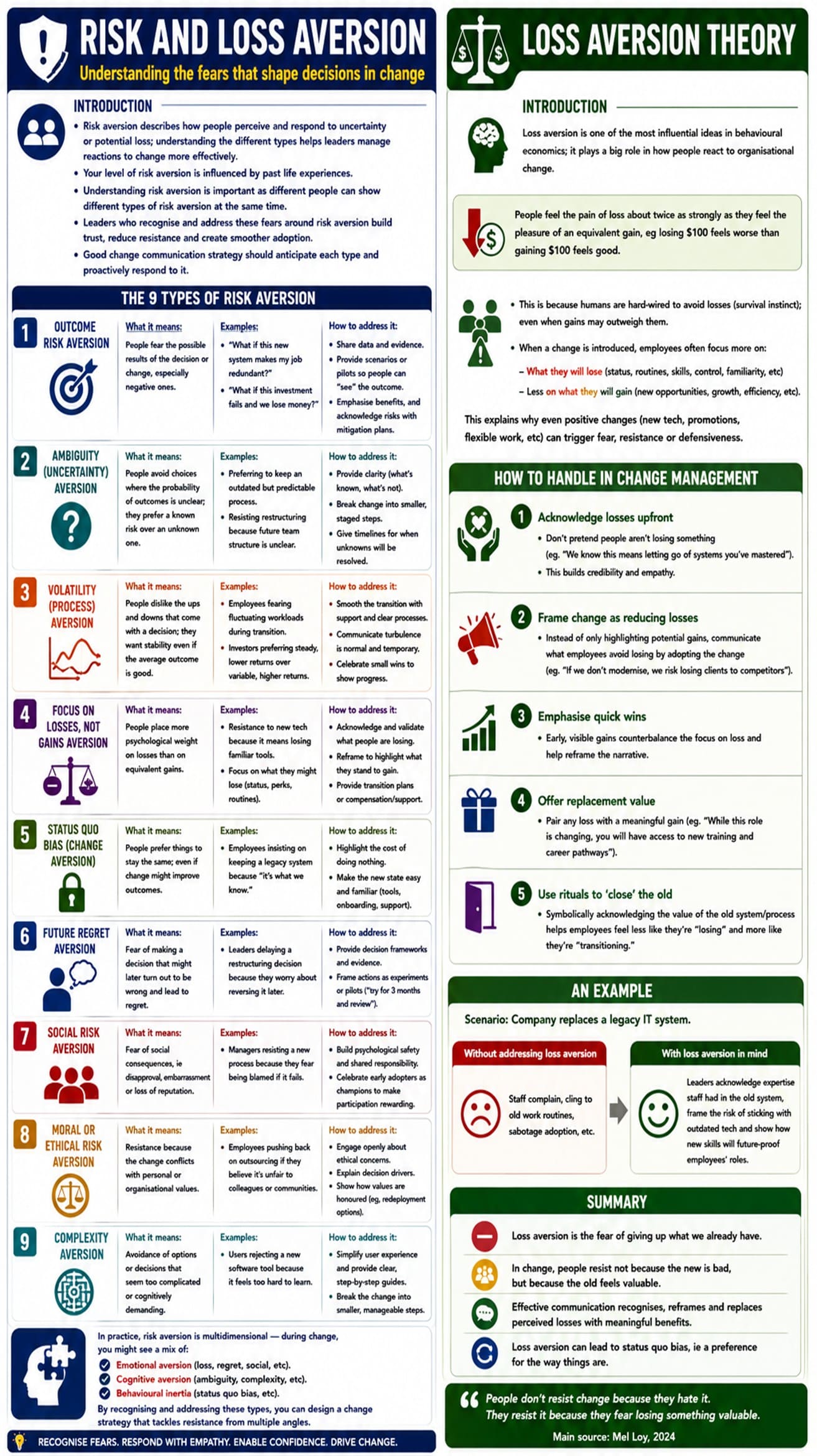
Loss aversion is one of the most influential ideas in behavioural economics; it plays a big role in how people react to organisational change.
People feel the pain of loss about twice as strongly as they feel the pleasure of an equivalent gain; losing $100 feels worse than gaining $100 feels good.
This is because humans are hard-wired to avoid losses (survival instinct), even when gains may outweigh them.
When a change is introduced, employees often focus more on:
- What they will lose (status, routines, skills, control, familiarity, etc)
- Less on what they will gain (new opportunities, growth, efficiency, etc).
This explains why even positive changes (new tech, promotions, flexible work, etc) can trigger fear, resistance or defensiveness.
How to Handle in Change Management
1. Acknowledge losses upfront
- Don’t pretend people aren’t losing something (eg, “We know this means letting go of systems you’ve mastered”).
- This builds credibility and empathy.
2. Frame change as reducing losses
- Instead of only highlighting potential gains, communicate what employees avoid losing by adopting the change (eg. “If we don’t modernise, we risk losing clients to competitors”).
3. Emphasise quick wins
- Early, visible gains counterbalance the focus on loss and help reframe the narrative.
4. Offer replacement value
- Pair any loss with a meaningful gain (eg, “While this role is changing, you will have access to new training and career pathways”).
5. Use rituals to ‘close’ the old
- Symbolically acknowledging the value of the old system/process helps employees feel less like they’re “losing” and more like they’re “transitioning”.
An Example
Scenario: Company replaces a legacy IT system.
- Without addressing loss aversion: Staff complain, cling to old work routines, sabotage adoption, etc.
- With loss aversion in mind: Leaders acknowledge expertise staff had in the old system, frame the risk of sticking with outdated tech and show how new skills will future-proof employees’ roles.
Summary
- Loss aversion is the fear of giving up what we already have.
- In change, people resist not because the new is bad, but because the old feels valuable.
- Effective communication recognises, reframes and replaces perceived losses with meaningful benefits.
- Loss aversion can lead to status quo bias: a preference for the way things are
(main source: Mel Loy, 2024)