
Linking Goodhart’s Law with Loss Aversion and Social Proof
Introduction
These concepts (Goodhart’s Law, loss aversion and social proof) really fit together when you think about human behaviour in change.
How They Interconnect
1. Goodhart’s Law – “When a measure becomes a target, it ceases to be a good measure.”
- Risk: People game metrics instead of truly embracing change.
- Impact in change: Creates the illusion of adoption without real behaviour shift.
(for more details see elsewhere in Knowledge Base)
2. Loss Aversion – “People fear losses more than they value equivalent gains.”
- Risk: Employees resist change because they focus on what they might lose (familiar processes, status, comfort, etc) more than what they might gain.
- Impact in change: Metrics designed to prove “success” may push people into defensive behaviours (minimising loss) rather than genuine engagement.
(for more details see elsewhere in Knowledge Base)
3. Social Proof – “We look to others to decide what’s correct or acceptable.”
- Risk/Opportunity: If early adopters are visibly gaming the system (Goodhart effect), others copy that behaviour. But if genuine champions model meaningful adoption, others follow too.
- Impact in change: Reinforces either true behaviour change or superficial compliance.
(for more details see elsewhere in Knowledge Base)
Combined Example
Imagine an organisation introducing a new project management tool.
- Goodhart’s Law: Leaders measure adoption by “number of projects created in the system. Employees create empty projects to hit the target, but continue managing work by email.
- Loss Aversion: Staff cling to email because it feels safer and more familiar than learning a new system (fear of mistakes, loss of efficiency).
- Social Proof: Seeing colleagues create fake projects to meet targets, others copy; thus, bad behaviour is reinforced.
Result: The change looks successful on paper but fails in practice.
How to Manage This Interplay
1. Design smarter measures (Goodhart-proofing)
- Use metrics that capture quality of adoption, not just activity.
- Example: Instead of “number of projects created”, measure “percentage of projects completed with milestones updated”.
2. Reduce perceived losses (Loss aversion)
- Show staff what they keep as well as what they gain; eg, “You’ll still have autonomy, plus the tool reduces administrative load”).
- Frame change as preventing bigger losses (eg, “If we don’t modernise, we risk losing customers to faster competitors”).
3. Leverage genuine social proof
- Appoint credible change champions who model real use of the new system.
- Publicly share success stories of people using the tool effectively, not just gaming it.
Summary
- Goodhart’s Law shows why bad metrics distort change behaviour.
- Loss aversion explains why people resist and may game systems to avoid perceived costs.
- Social proof magnifies whatever behaviours are most visible, good or bad.
Together, they remind change leaders to choose meaningful measures, reduce perceived losses and showcase genuine adoption to drive real transformation.
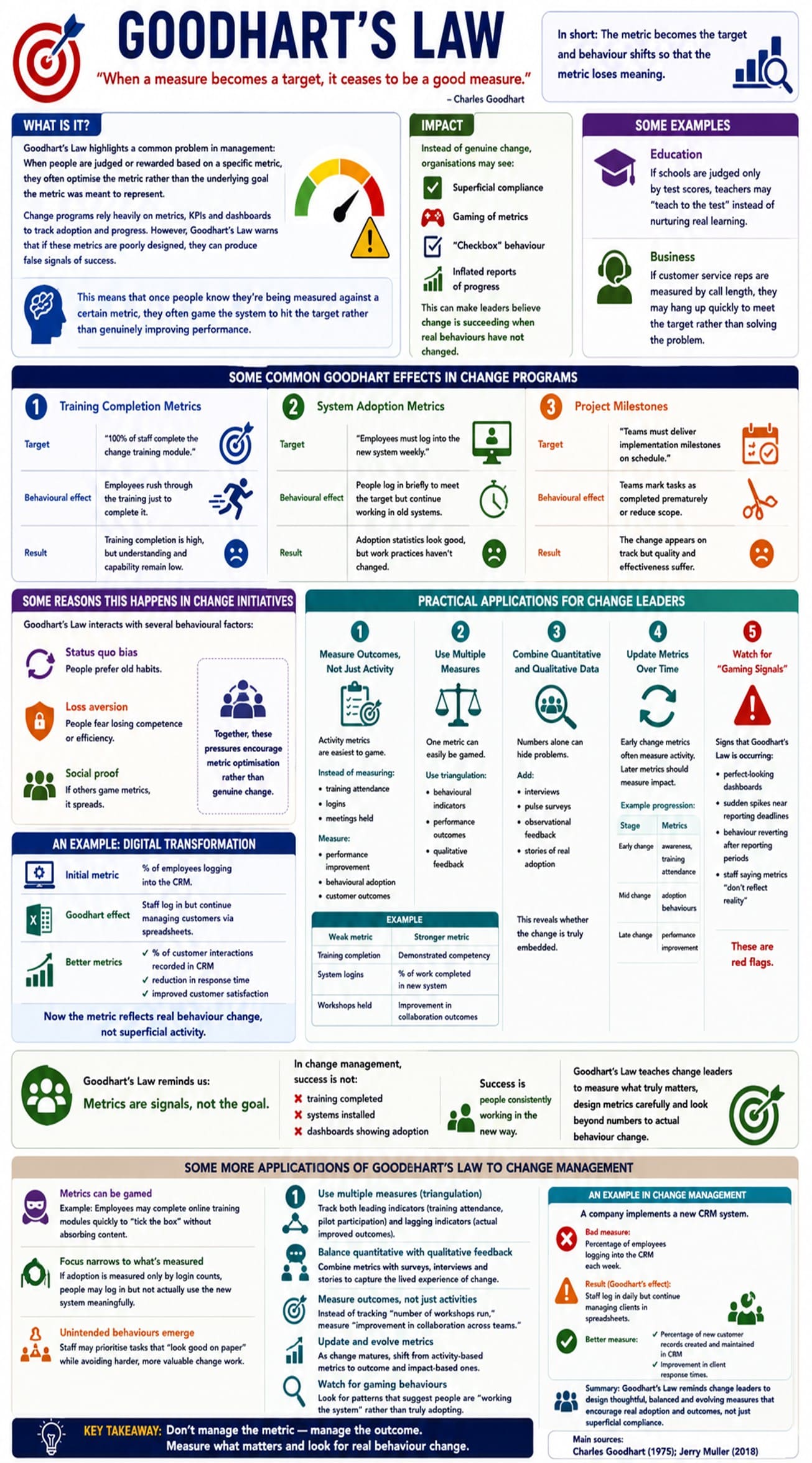
(main sources: Charles Goodhart, 1975; Jerry Muller, 2018)