
Some More Applications of Goodhart’s Law to Change Management
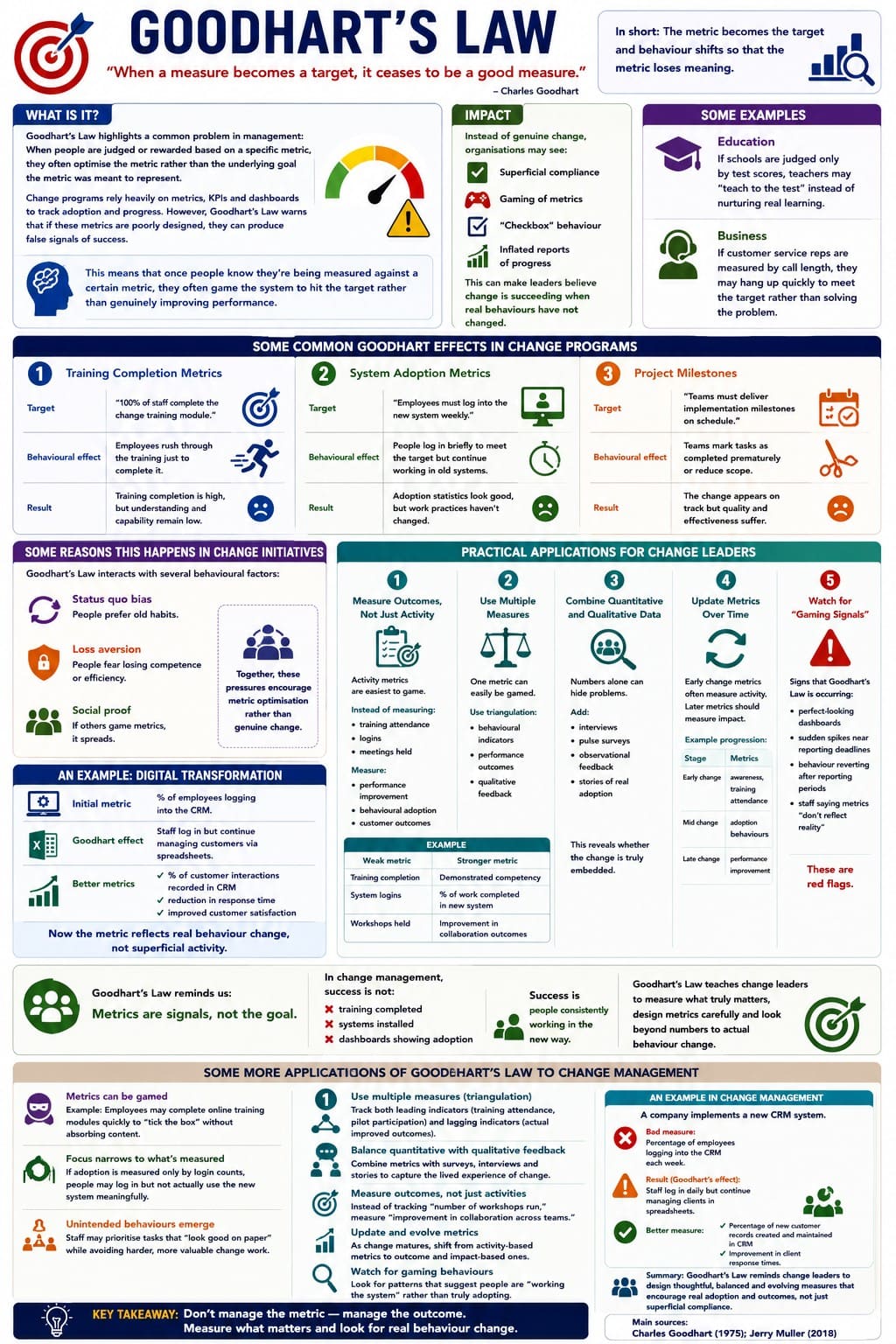
When leading change, leaders often use KPIs, dashboards and adoption metrics to track progress.
However, Goodhart’s Law warns that:
1. Metrics can be gamed
- Example: Employees may complete online training modules quickly to “tick the box” without absorbing content.
2. Focus narrows to what’s measured
- If adoption is measured only by login counts, people may log in but not actually use the new system meaningfully.
3. Unintended behaviours emerge
- Staff may prioritise tasks that “look good on paper” while avoiding harder, more valuable change work.
🔹 How to Avoid Goodhart’s Trap in Change
1. Use multiple measures (triangulation)
- Track both leading indicators (training attendance, pilot participation) and lagging indicators (actual improved outcomes).
2. Balance quantitative with qualitative feedback
- Combine metrics with surveys, interviews and stories to capture the lived experience of change.
3. Measure outcomes, not just activities
- Instead of tracking “number of workshops run,” measure “improvement in collaboration across teams.”
4. Update and evolve metrics
- As change matures, shift from activity-based metrics to outcome and impact-based ones.
5. Watch for gaming behaviours
- Look for patterns that suggest people are “working the system” rather than truly adopting.
An Example in Change Management
A company implements a new CRM system.
- Bad measure: Percentage of employees logging into the CRM each week.
- Result (Goodhart’s effect): Staff log in daily but continue managing clients in spreadsheets.
- Better measure: Percentage of new customer records created and maintained in CRM and improvement in client response times.
Summary:
Goodhart’s Law reminds change leaders to design thoughtful, balanced and evolving measures that encourage real adoption and outcomes, not just superficial compliance.
Metrics are signals, not the goals.
In change management, success is not:
- training completed
- systems installed
- dashboards showing adoption
Success is people consistently working in the new way.
Goodhart’s Law teaches change leaders to measure what truly matters, to design metrics carefully and to look beyond numbers to actual behaviour change
(main sources: Charles Goodhart, 1975; Jerry Muller, 2018)