
Chunking (part of cognitive load theory)
Introduction
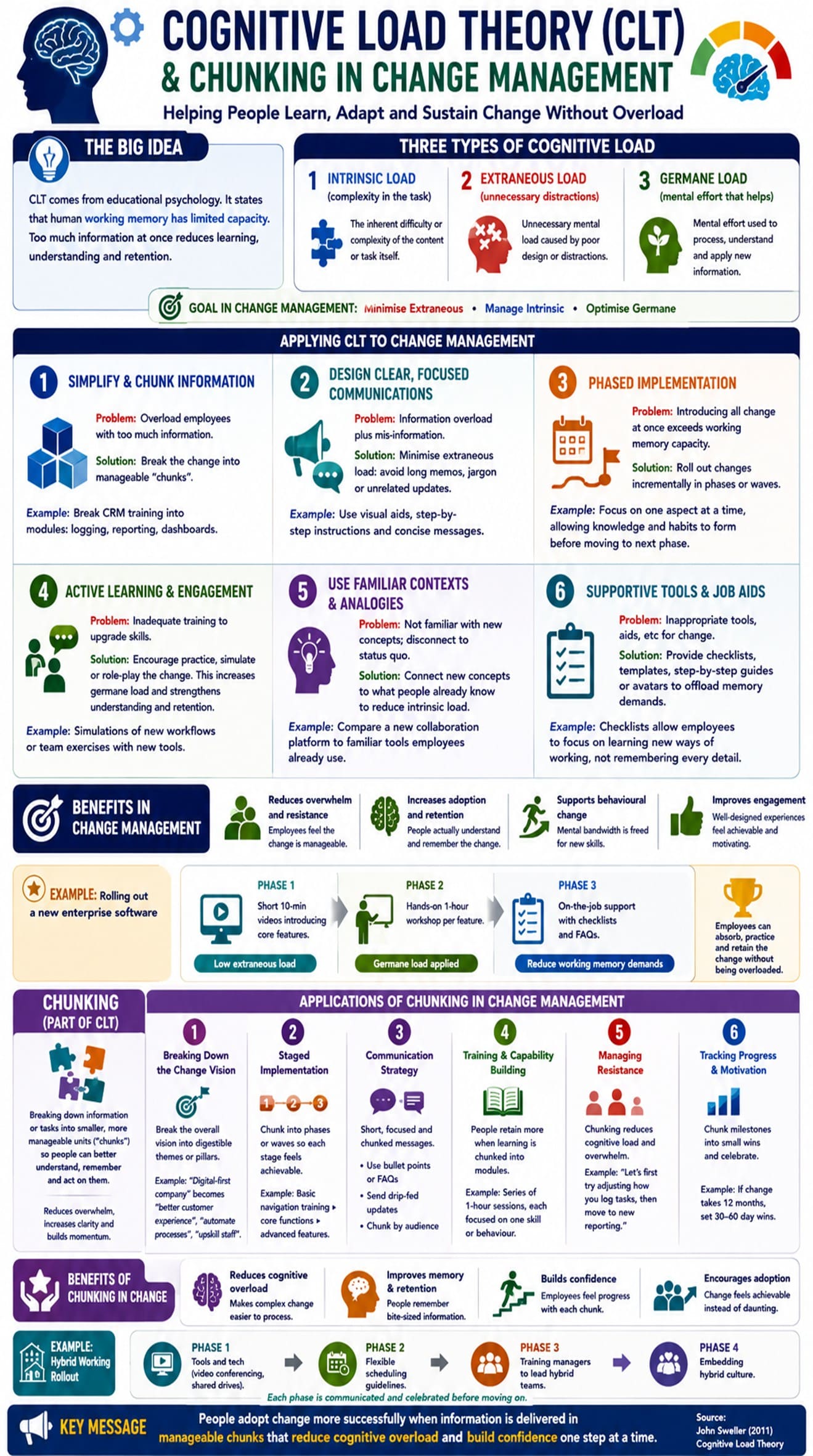
Chunking is a powerful concept in psychology and learning that has strong applications in change management.
Chunking means breaking down information or tasks into smaller, more manageable units (“chunks”) so people can better understand, remember and act on them.
In change management, this helps reduce overwhelm, increase clarity and build momentum.
Applications of Chunking in Change Management
1. Breaking Down the Change Vision
- Instead of overwhelming employees with the entire transformation, leaders can break the vision into digestible themes or pillars of change.
- Example: Instead of “We’re becoming a digital-first company,” chunk it into “improving customer experience,” “automating back-office processes,” and “upskilling staff.”
2. Staged Implementation
- Large-scale change can feel unmanageable; by chunking into phases or waves, each stage feels achievable.
- Example: In rolling out a new IT system, start with basic navigation training, then core functions, followed by advanced features instead of teaching everything at once.
3. Communication Strategy
- Change communication works best when messages are short, focused and chunked.
- Techniques include:
- Using bullet points or FAQs
- Sending drip-fed updates instead of one long memo
- Chunking by audience (what frontline staff need to know vs. managers vs. executives).
4. Training & Capability Building
- Learning science shows people retain more when information is chunked into modules.
- Example: Instead of a full-day workshop, run a series of 1-hour sessions, each focusing on one change skill or behaviour.
5. Managing Resistance
- Resistance often comes from feeling overwhelmed; chunking reduces cognitive load.
- Example (instead of saying “You must completely change the way you work,” frame it as “Let’s first try adjusting how you log tasks, then later we’ll move to new reporting.”)
6. Tracking Progress & Motivation
- Chunking allows teams to celebrate small wins.
- Example (if change takes 12 months, chunk milestones into 30-60 day wins).
Benefits of Chunking in Change
- Reduces cognitive overload (makes complex change easier to process).
- Improves memory & retention (people remember bite-sized information).
- Builds confidence (employees feel progress with each chunk).
- Encourages adoption (change feels achievable instead of daunting).
An Example:
An organisation introducing hybrid working doesn’t launch every new policy at once. Instead, it chunks the rollout:
- Phase 1 – Tools and tech (video conferencing, shared drives).
- Phase 2 – Flexible scheduling guidelines.
- Phase 3 – Training managers to lead hybrid teams.
- Phase 4 – Embedding hybrid culture.
Each phase is communicated and celebrated before moving on.
(main source: John Sweller, 2011)