
Some Ways to Reduce Gaps (Intention–Behaviour and Behaviour–Perception)
Reducing the Intention–Behaviour Gap
(“I mean to change, but I don’t follow through.”)
Techniques for Leaders
- Make it easy to act
- Simplify new behaviours (fewer steps, automated prompts, etc).
- Remove obstacles (time, access, tools, etc).
- Turn intentions into commitments
- Encourage employees to set small, public goals (“I will use the new template for my next report”).
- Use team check-ins to reinforce progress.
- Use nudges and reminders
- Visual cues, prompts in software or leaders modelling the behaviour daily.
- Example: Quick pop-up in the new system reminding staff how to log tasks.
- Reward small wins
- Celebrate early adopters.
- Link behaviours to recognition, not just outcomes.
- Provide capability and confidence
- Training, peer support, and mentoring to build skills.
- Confidence turns intention into sustained behaviour.
Reducing the Behaviour–Perception Gap
(“I think I’m acting one way, but people see it differently.”)
Techniques for Leaders
- Make intent explicit
- Always link actions to intent:
“I’m setting firm deadlines not to pressure you, but to protect your workload later.”
- Always link actions to intent:
- Check for understanding
- Ask: “What did you hear me say?” or “How does this come across to you?”
- Close the loop instead of assuming clarity.
- Invite feedback on behaviour
- Create safe spaces for employees to say: “When you said X, I felt Y.”
- Regular pulse checks or anonymous feedback channels help.
- Align words and actions
- Ensure behaviour matches the message (e.g., don’t say “collaboration matters” but then make decisions in isolation).
- Consistency builds credibility.
- Acknowledge perception differences
- If misperception arises, clarify without defensiveness:
“I hear that my message came across as harsh. What I intended was to stress urgency, not criticism.”
- If misperception arises, clarify without defensiveness:
Summary
- Intention–Behaviour gap (close it with clarity, simplicity, nudges, support, and reinforcement.)
- Behaviour–Perception gap (close it with transparency, feedback loops, explicit intent and aligned actions.)
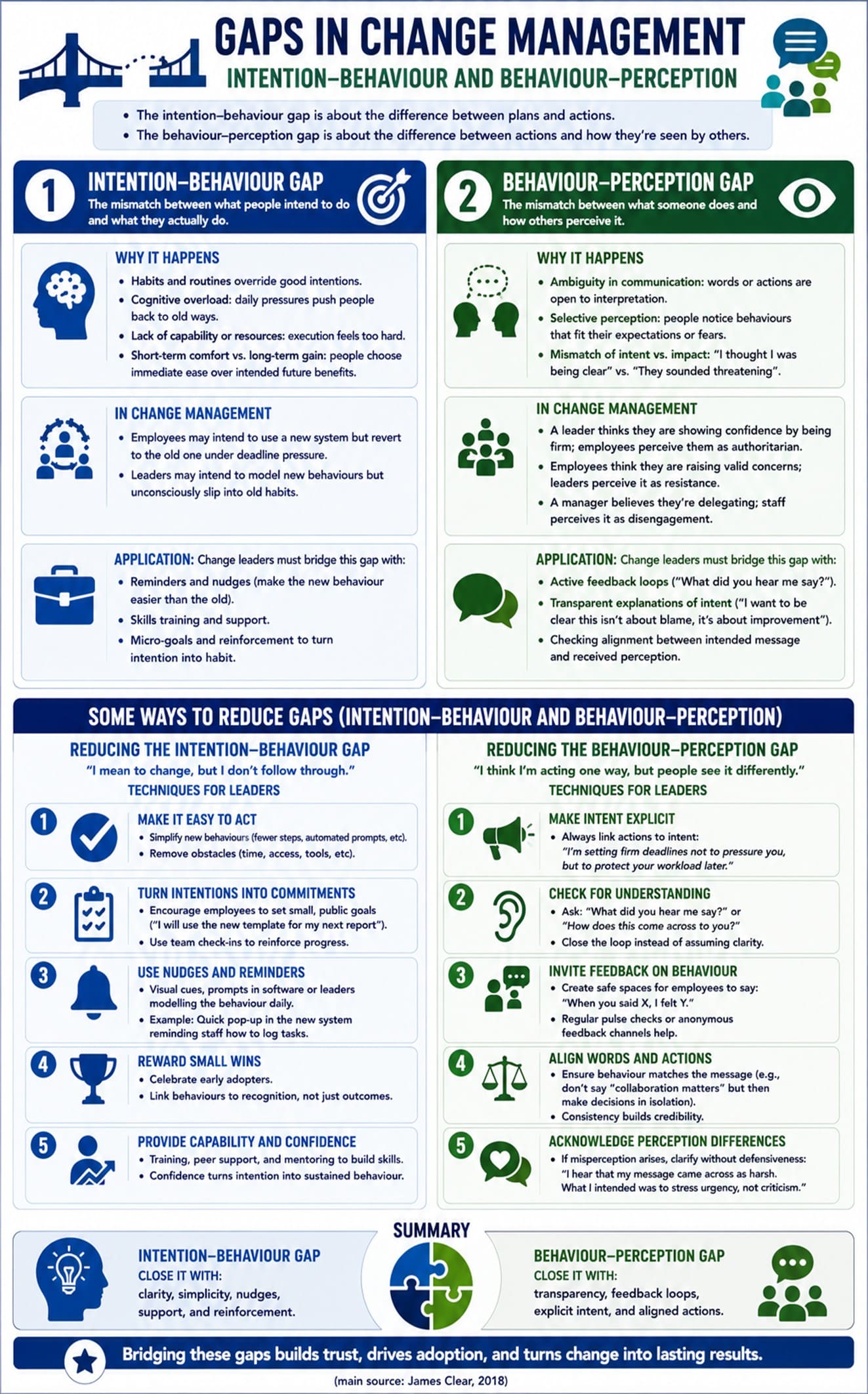
(main source: James Clear, 2018)