
More on Rewiring Bias: The Neuroscience of Inclusion and Anti-Racism
Introduction
The purpose is to help people understand the neuroscience of bias and racism, create psychological safety for honest reflection, and build new inclusive habits through experiential learning.
Need to
- explain how the brain creates and reinforces bias.
- recognise personal and systemic sources of racism.
- use neuroscience-based strategies to reduce bias.
- apply inclusive behaviours that promote belonging.
- commit to actions that reinforce fairness and empathy in daily work.
- focus on reflection and learning and avoid debating.
- reinforce that this is not about shame, but about growth and accountability
- model vulnerability (“I’ve had to unlearn my own biases too”).
- teach the habit loop: Cue to Routine to Reward.
(For more details, see elsewhere in the Knowledge Base)
- ask participants to identify one bias trigger (eg, making assumptions about accents).
- replace with a new routine (pause, ask a question, or check facts).
- discuss how recognition and reward create dopamine reinforcement.
- align personal change with organisational structures.
- ask: “Where in our system could bias hide—recruitment, meetings, performance reviews?”
- design one change that promotes fairness or voice.
- share actions and commit to follow-up within 60 days.
- embed learning and commitment.
- focus on gratitude and openness.
- invite voluntary sharing of commitments.
(For more details, see elsewhere in the Knowledge Base)
NB Inclusion and racism start in the brain but grow through daily choices.
Some Facilitation Tips
- speak calmly and avoid moralising language.
- stay curious but grounded
- use body language that signals openness (eye contact, relaxed posture, etc).
- pause often as people need time for neural and emotional processing.
- if tension rises, slow down the pace, breathe and name the emotion safely.
- keep redirecting from guilt to responsibility, ie “We can rewire our wiring.”
Session Outline
|
Session |
Focus |
Duration |
|
1. Welcome & Safety |
Set tone and trust |
45 min |
|
2. Bias in the Brain |
Awareness of neural wiring |
60 min |
|
3. Empathy Rewiring |
Emotion-based learning |
90 min |
|
4. Positive Contact |
New neural associations |
60 min |
|
5. Habits of Inclusion |
Practice and embedding |
60 min |
|
6. Accountability |
Systems and culture |
45 min |
|
7. Reflection |
Consolidation and commitment |
30 min |
Session Details
Session 1: Welcome and Psychological Safety (45 min)
Objective: Create openness and reduce defensiveness.
Facilitator steps:
- Open with ground rules: respect, confidentiality, curiosity, no judgment.
- Frame bias as a neural shortcut, not moral failure.
- Explain amygdala + prefrontal cortex in simple terms (fight/flight vs reason/regulate).
- Activity: “One time I changed my mind.” Participants share in pairs.
Debrief:
- What helped you change your mind?
- What emotions came up?
- Link to how safety allows the brain to learn.
Session 2: Bias in the Brain (60 min)
Objective: Understand automatic categorisation and its roots.
Facilitator steps:
- Short presentation: how the brain creates in/out groups.
- Discuss ventral striatum (reward for belonging) and amygdala (threat detection).
- Activity: Bias Mapping. In small groups, identify where stereotypes appear (media, policies, daily talk).
- Reflection: Write privately—'What stories about difference shaped my worldview?'
Debrief:
- How do these stories show up at work?
- What parts of the brain reinforce them?
Session 3: Rewiring Through Empathy (90 min)
Objective: Activate empathy networks and rehumanise out-groups.
Facilitator steps:
- Show a 3–5 min video or story of lived racial experience.
- Ask: 'What emotions surfaced?'
- Pair-share: each partner listens silently for 2 minutes, then reflects back what they heard.
- Explain mirror neurons: empathy builds new neural associations.
Debrief:
- How did listening without interruption feel?
- What changed in how you perceived the story?
Session 4: Exposure and Contact (60 min)
Objective: Build positive, safe interaction with difference.
Facilitator steps:
- Introduce guest speakers or diverse team members.
- Mixed-group dialogue: 'What’s one barrier and one bridge to inclusion in our organisation?'
- Cooperative mini-task: design a small initiative (e.g., cross-cultural mentorship).
Debrief:
- What helped you connect across difference?
- What felt uncomfortable but useful?
Session 5: Building Habits of Inclusion (60 min)
Objective: Translate insight into daily behaviour.
Facilitator steps:
- Teach the habit loop: Cue → Routine → Reward.
- Ask participants to identify one bias trigger.
- Replace with new routine (pause, ask, or check facts).
- Discuss recognition and reward (dopamine reinforcement).
- Group brainstorm: how to make inclusion visible and valued.
Debrief:
- What’s one habit you’ll try this week?
- How can your team support you?
Session 6: Accountability and System Change (45 min)
Objective: Align personal change with organisational structures.
Facilitator steps:
- Ask: 'Where could bias hide—recruitment, meetings, reviews?'
- In small groups, design one change that promotes fairness.
- Share actions and commit to follow-up within 60 days.
Debrief:
- What’s one barrier to sustaining this change?
- Who will you partner with for accountability?
Session 7: Reflection and Close (30 min)
Objective: Embed learning and commitment.
Facilitator steps:
- Guide mindfulness reflection.
- Ask: 'What new understanding will you act on?'
- Invite sharing of commitments.
- End with group affirmation: 'Inclusion starts in the brain but grows through daily choices.'
6. Post-Workshop Follow-Up
- 21-Day Challenge: daily reflection or inclusive micro-action.
- Peer Check-In: partner accountability chat after 3 weeks.
- Follow-Up Session (Day 60): share progress and reinforce learning.
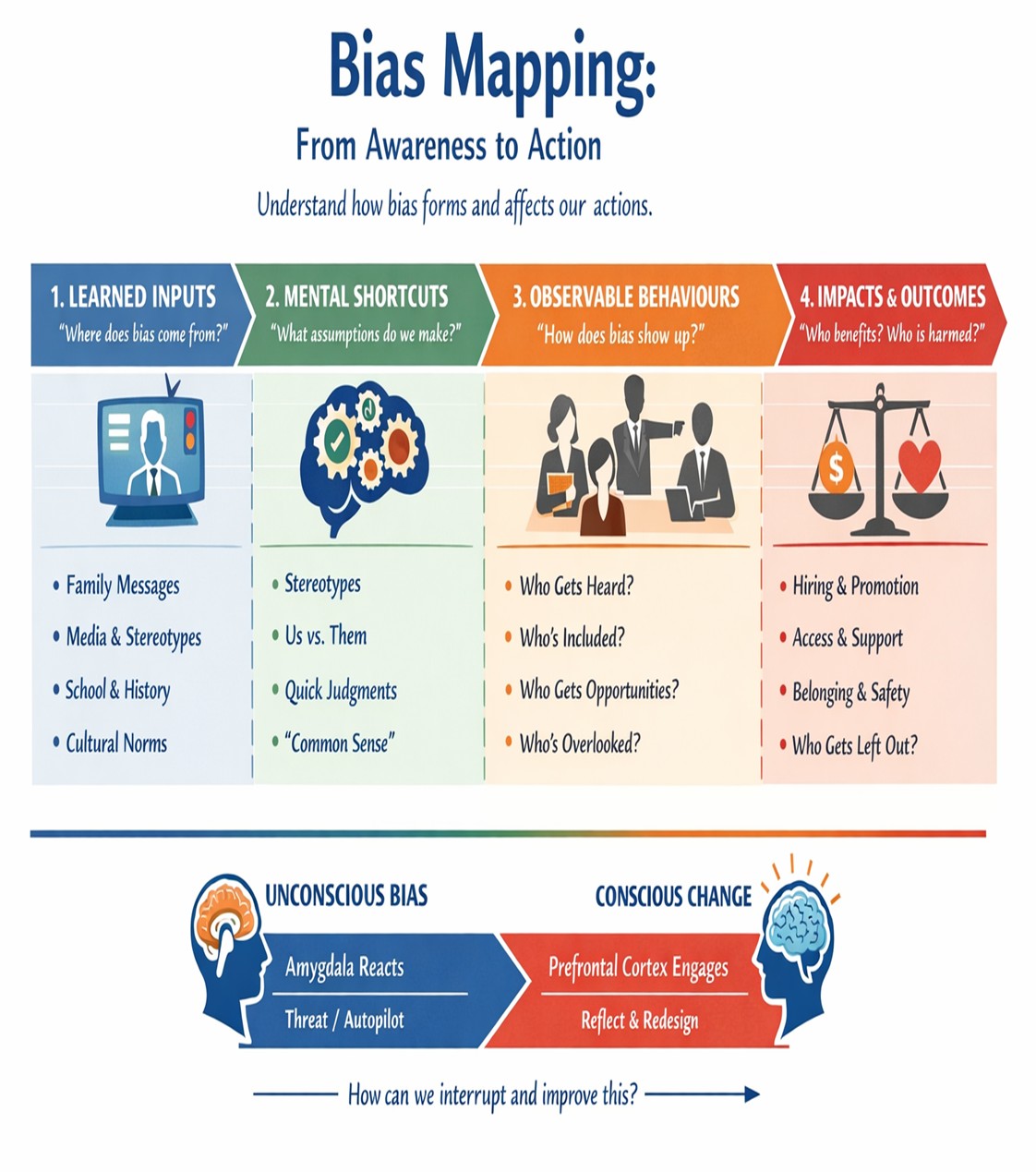
(main sources: Jennifer L. Eberhardt, 2019; David M Amodio et al, 2021)