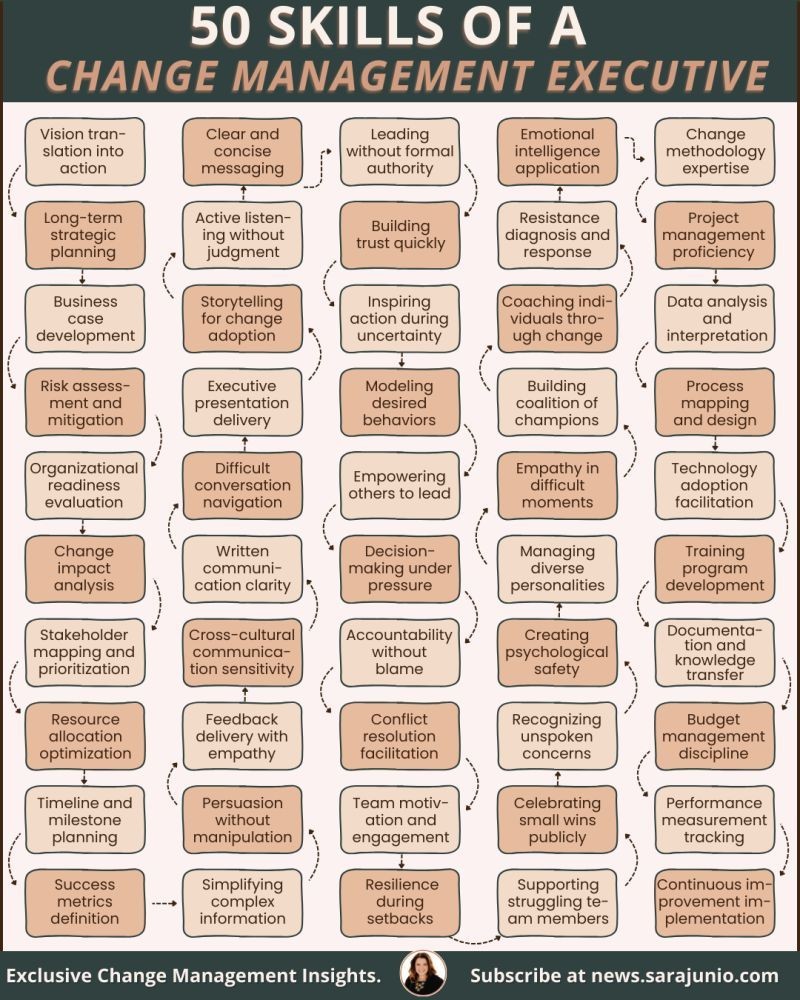
Work Skills in Change Management
Introduction
- Most people think change management is about frameworks (including timelines, methodologies, processes, systems, structure, strategies, routines, procedures, resource allocation, etc.). Change management is more about people who can be messy, complex and unpredictable. That's why attitudes and emotional topography matter more than the hard skills, certifications, etc.
- Strategy gets you started; people skills get you finished. People skills determine if change sticks.
- You can build the perfect change plan (including beautiful Gantt charts, clear milestones, detailed budgets, etc). However,
- if you can't read resistance
- if you can't navigate difficult conversations
- If you can't inspire actions when everything feels uncertain,
your plan dies on a spreadsheet.
- Communication isn't about talking; it's about translating. Executives speak numbers while frontline teams speak impact. A change agent’s job is to bridge the gap; some examples:
- take a complex transformation and make it feel simple
- take a scary future and make it feel possible
- take a corporate mandate and make it feel personal, etc. - Most change executives have limited authority, as they do not:
- control budgets.
- hire or fire
- have positional power, etc.
- influence that is built on trust
- credibility earned through competence
- respect gained by showing up when things get hard, etc.
- As change can be very complicated with increasing organisational complexity and socio-technical uncertainty, organisational change capacity needs to build and enhanced. Building true organizational change capacity involves leading change in ways that are appropriate to the situation.
“…The change capacity of the organization refers to (a) the willingness and ability of changemakers to assume responsibility for the change, (b) the existence of a supportive infrastructure that facilitates change, and (c) sufficient resources appropriate for the change. The concept of changemakers goes well beyond top-management change leaders and strategists and includes mid-level implementers and lower-level participants and recipients. Each of these groups brings a very different role, mindset and orientation to the change and can experience the change in different ways……An organization's change capacity is influenced by the extent to which all three groups- change strategists, implementers, and recipients- have a similar understanding of the change process and its appropriateness to the situation…”
Kenneth Kerber et al, 2005
- The low success rate (around 30%) of effective organisational change may be due in large part to a mismatch between the requirements of the situation and the approach to change that is implemented.
- Change involves a great range of skills as some days require:
- strategic thinking
- understanding someone's fear
- presentations to all organisational levels
- ability to move people through uncertainty
- quiet one-on-one conversations, etc.
NB Great change leaders flex between all of them.
(main source: Sara Junio, 2025)