
AI Maturity Curve
Introduction
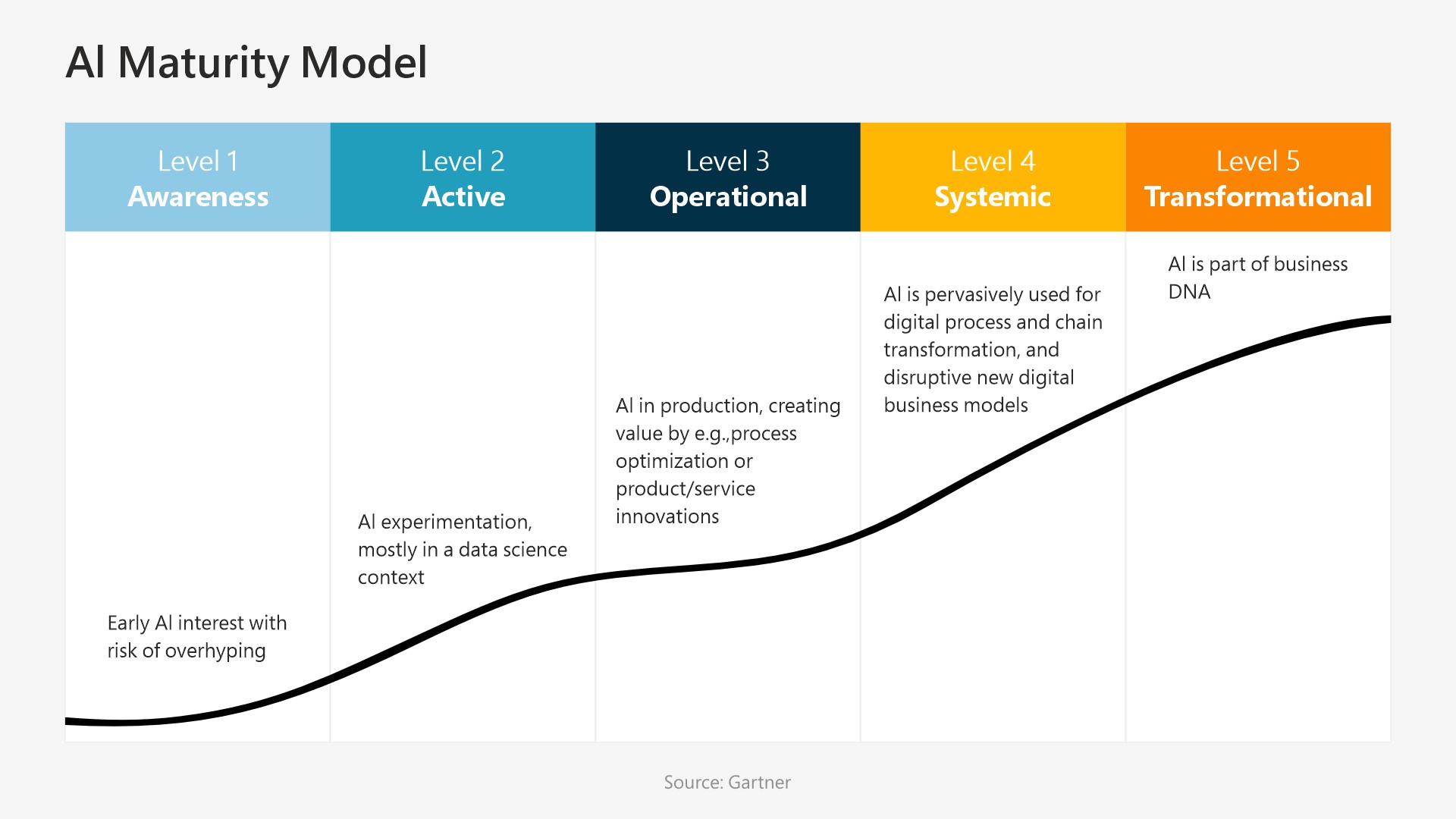
The AI Maturity Curve describes how organisations progressively develop their capability, confidence, governance and culture to use AI effectively and responsibly.
Crucially, AI maturity is far more about people, mindset and operating model than algorithms.
(source: https://www.usaii.org/ai-insights/understanding-ai-maturity-levels-a-roadmap-for-strategic-ai-adoption)
The Stages in the AI Maturity Curve
Stage 1: Awareness (AI as Hype)
Mindset
- “AI is coming”
- Curiosity mixed with fear
- High speculation, low understanding
Behaviour
- Talks, demos, newsletters
- No ownership
- Fear of job loss or irrelevance
Change Management Implications
- Emotional response dominates (anxiety, resistance)
- Rumours spread faster than facts
- Low trust
Change Leader Focus
- Sense-making
- Psychological safety
- Honest conversations about impact
Stage 2: Experimentation (AI as Tool)
Mindset
- “Let’s try some examples”
- AI seen as productivity enhancer
Behaviour
- Pilots, proofs of concept
- Isolated teams experimenting
- Tools adopted without integration
Change Management Implications
- Change fatigue risk
- Shadow AI use
- Uneven capability across teams
Change Leader Focus
- Safe-to-fail experiments
- Clear guardrails
- Capability uplift (basic AI literacy)
Stage 3: Operationalisation (AI as Process)
Mindset
- “AI can improve how we work”
- Focus on efficiency and scale
Behaviour
- AI embedded in workflows
- Formal governance emerges
- Clear ROI expectations
Change Management Implications
- Role redesign begins
- Identity threat for some roles
- Strong need for reskilling
Change Leader Focus
- Job redesign conversations
- Fairness and transparency
- Change readiness and adoption metrics
Stage 4: Systemic and Integration (AI as Partner)
Mindset
- “Humans + AI outperform either alone”
- Trust in AI decisions (with oversight)
Behaviour
- Cross-functional AI use
- Decision support embedded
- Data-driven culture strengthens
Change Management Implications
- Power shifts (who decides?)
- Ethical and accountability questions
- Cultural norms change
Change Leader Focus
- Decision rights clarity
- Ethics, bias and accountability
- Leadership behaviour modelling
Stage 5: Transformation (AI as Capability)
Mindset
- “AI is core to how we create value”
- Continuous learning culture
Behaviour
- New business models
- AI-enabled strategy
- Workforce evolves dynamically
Change Management Implications
- Continuous change becomes normal
- Traditional change programs become obsolete
- Leadership identity transforms
Change Leader Focus
- Adaptive leadership
- Talent ecosystem thinking
- Continuous engagement and renewal.
(main source: Accenture, 2022)