
Framework 19 Transformational Triangle (Shell)
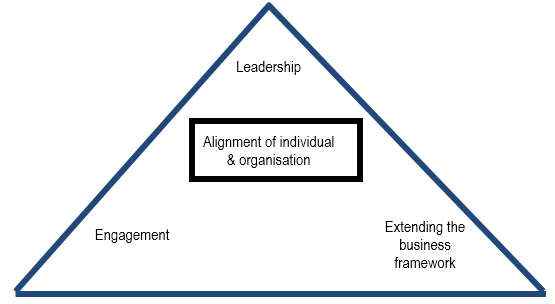
There are 4 critical elements (including 3 types of collective activity) in an organisational change campaign as part of the transformational triangle
1. Fostering new types of leadership, ie a move from seeing senior leaders as decision-making bodies to seeing them as open to learning and responsible for nurturing the next generation of leaders. This is a generic shift from "leaders as commanders" to "leaders as servants" (have the authority to do what he or she thinks is right, and to be responsible for consequences). An important part of this is the opportunity to stop to reflect on one's own development. Furthermore, status and reward must be unhitched from hierarchical position and power.
2. Extending the business framework, ie especially by being commercially competent (knowing how to run a business)
3. Engaging the organisation in a way that helps catalyse more energising attitudes and practices. It is primarily a process of listening to people, not talking at them; with a need to develop the basic skills of listening to people and letting their ideas make an impression. This involves a paradigm shift away from automatic loyalty and obedience to the management system in exchange for security. Nowadays, security only lies in performance, ie ability to add value. This has increased the degree of uncertainty and accountability for each one of us for our actions and personal development. Instead of loyalty, organisations ask for commitment. It is up to the organisation and its leadership to provide the kind of environment where people give the commitment freely. In exchange, the organisation is responsible for helping people to build their skills to create an environment where they can control whether or not their particular business unit is successful. This involves fostering learning instead of training.
4. Aligning individual aspirations and attitudes to the goals envisioned of the organisation as a whole, ie this involves asking the following questions
- Is what we are doing consistent with the good of the organisation?
- Can we get other people to see things the same way?
- Is the organisation aligned with the staff's interest, their families' interests and their values?
- Are we willing to expose our failures?
- Is our organisation an "employer of choice"?
(source: Phillip Carroll, 1999)